HPTLC Fingerprinting and PCA: Advancing Identity Testing of a Multi-Species Natural Product Blend
Natural product matrices are inherently complex and are characterized by diverse secondary metabolite profiles. When multiple concentrated botanical or fungal extracts are incorporated into a single formulation, this chemical complexity increases significantly. Consequently, quality testing faces unique challenges in verifying the identity and compositional integrity of the individual constituent species within a finished blend. This challenge is further complicated by the lack of certified reference standards for multi-component fungal blends.
To address this gap, our laboratory is advancing routine quality control by combining HPTLC fingerprinting, strategic sampling, and chemometric analysis. This approach shifts the evaluation process from subjective visual assessment to objective, data-driven verification, enabled by the release of visionCATS AI Tools earlier this year.
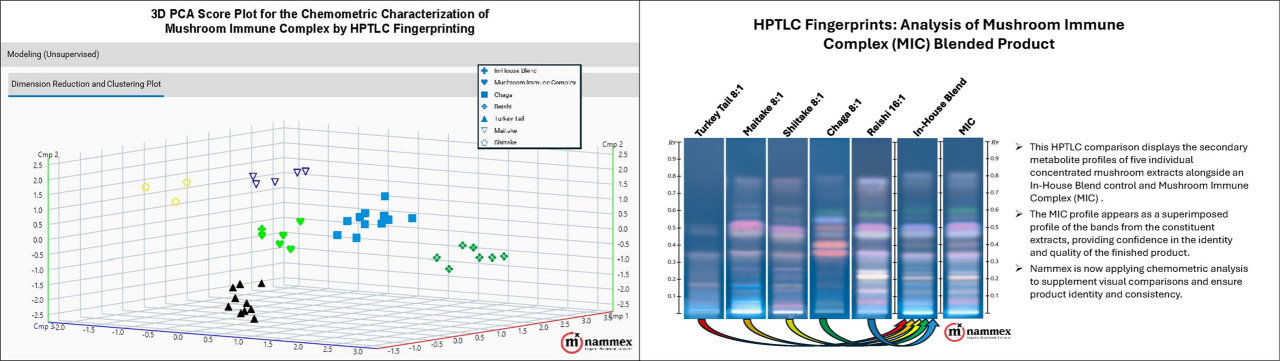
The analytical workflow begins with the generation of chromatographic fingerprints using methods previously described¹. The HPTLC profile of Nammex’s Mushroom Immune Complex (a blend of concentrated extracts of Turkey Tail, Reishi, Chaga, Maitake, and Shiitake) appears as a superimposed profile of the bands from the constituent extracts, thereby providing confidence in the identity and quality of the finished product. To further verify this visual interpretation, the digital fingerprint data are processed using unsupervised 3D PCA modeling to automate pattern recognition, statistical modeling, and sample classification.
Although natural products inherently vary depending on growing conditions, strain, and extraction processes, the statistical model condenses this large dataset into three principal dimensions. Within this 3D chemical space, different production lots of the same species cluster together distinctly. This demonstrates that despite biological and manufacturing variability, the core chemical profile of each ingredient remains highly consistent and identifiable.
Importantly, the commercial finished product and the in-house blend control (prepared from identity-verified reference materials combined according to the finished product ratio) form a tight, overlapping cluster. The spatial proximity between the commercial sample and the reference control supports analytical traceability. Furthermore, because this cluster is positioned centrally relative to the individual ingredient clusters, the model provides statistical evidence that the finished blend retains balanced and measurable chemical contributions from all constituent extracts.
By integrating automated statistical tools into routine testing, this chemometric methodology complements traditional visual evaluation. The approach enables verification of the consistency of the finished blend across the entire chemical fingerprint and assessment of its conformity to identity-verified reference materials. To further strengthen the model, additional independent lots will be analyzed, more blended controls will be prepared, and densitometric scans at specific wavelengths will be investigated.
-----
1 Windsor, C.; Kreynes, A.E.; Chilton, J.S.; Chioffi, W.A.; Krishnamurthy, A.; Ishii, M. Comparative Study of Chaga (Inonotus obliquus) Dietary Supplements Using Complementary Analytical Techniques. Int. J. Mol. Sci. 2025, 26(7), 2970. https://doi.org/10.3390/ijms26072970
Comments
Leave a comment